 EN
EN
Engineering Precision for Extreme Track Day Demands
Upgrading dedicated track cars and time-attack builds with aftermarket wheels always requires an uncompromising focus on mechanical precision and structural resilience. Having spent years collaborating with professional racing teams, suspension tuners, and aerodynamic specialists across various circuit configurations, technical engineers consistently observe that competitive motorsports demand far more from wheel assemblies than standard street driving. When high-performance sports cars corner aggressively at high speeds, generating sustained lateral forces surpassing normal driving thresholds, factory or low-grade cast wheels frequently experience microscopic flex or bead separation. Real-world operational experience on demanding circuits shows that racers seeking immediate steering response and precise cornering lines often encounter performance degradation when using rigid, non-adjustable wheels that cannot be custom-tailored to unique track-width requirements. Transitioning to high-performance forged three piece wheels fundamentally solves this competitive challenge by offering modular adaptability combined with the extreme structural rigidity necessary to dominate technical race tracks. Furthermore, investing in properly engineered multi-piece wheels protects overall suspension geometry and ensures long-term vehicle safety under extreme racing conditions across diverse international racing circuits.
The Structural Ingenuity and Modularity of Three-Piece Architecture
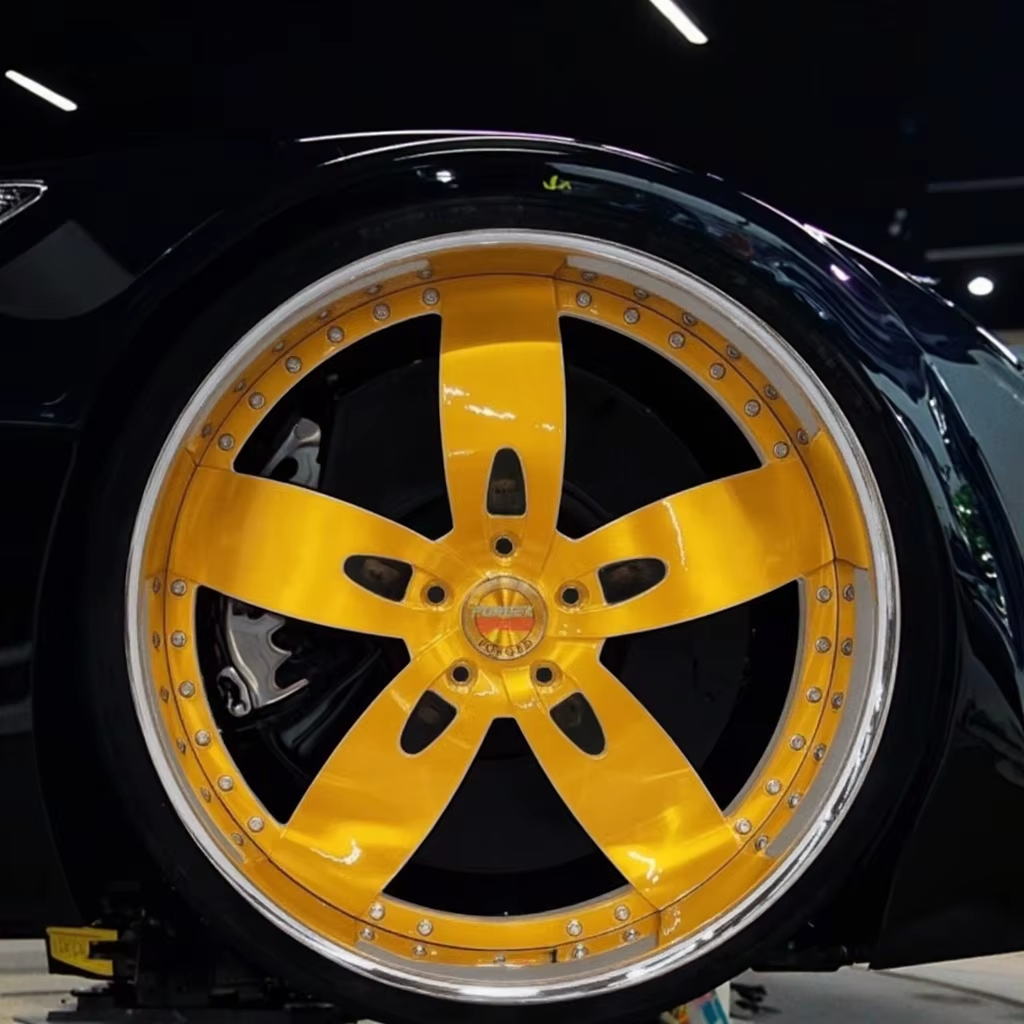
Understanding why multi-piece wheels dominate professional motorsports requires a close examination of their unique architectural design and assembly mechanics. Unlike monolithic cast or single-piece forged wheels, a three-piece wheel consists of a forged center disk, an outer rim flange, and an inner rim barrel, all securely joined together using high-strength titanium or aerospace-grade fasteners. Automotive engineering associations emphasize that this modular construction allows race teams to precisely alter offset, width, and backspacing to fit aggressive widebody kits and specialized big brake caliper clearances without redesigning an entirely new wheel mold. For track builds, this structural decoupling means that if a rim lip sustains minor curb damage during an aggressive cornering mishap, technicians can replace just the damaged outer flange rather than discarding the entire wheel assembly. This modularity not only lowers long-term maintenance costs for racing stables and enthusiast teams but also provides ultimate design flexibility for bespoke vehicle configurations.
Metallurgical Excellence and Advanced Multi-Axis Forging Mechanics
Achieving supreme structural strength and minimal rotational mass in a three-piece racing wheel begins with the metallurgical selection and advanced forging execution of the center disk. Premium manufacturing standards dictate the use of solid aerospace-grade aluminum blocks subjected to immense hydraulic pressure exceeding thousands of tons during the multi-axis forging process. Materials science research confirms that this extreme mechanical compression aligns the metal grain structure closely with the contours of the spoke design, completely eliminating internal porosities, microscopic voids, and structural weak points. For track applications, this structural density translates directly into superior load-bearing capacity and enhanced impact resilience when hammering over high curbs or rough track rumble strips at high speeds. Furthermore, the directional alignment of the metal fibers allows engineers to machine intricate, lightweight spoke profiles that maintain maximum structural integrity while shedding every unnecessary gram of rotating weight.
Optimizing Rotational Inertia, Brake Cooling, and Vehicle Dynamics
Motorsports dynamics experts frequently remind racing drivers and crew chiefs that reducing rotational inertia and unsprung weight yields exponential improvements in acceleration, braking efficiency, and lap times. Because the outer and inner barrels of a three-piece wheel can be optimized for specific wall thicknesses while the forged center handles high torsional loads, the total assembly weight is drastically reduced compared to conventional cast rims. Every pound of rotating mass eliminated from the four corners of a track car translates into shorter braking zones, sharper turn-in response, and more efficient power transfer to the pavement. Additionally, the open design architecture of multi-piece configurations promotes superior airflow across high-performance brake rotors and multi-piston calipers, mitigating brake fade during prolonged endurance racing stints. Fleet managers and professional race engineers confirm that these dynamic enhancements compound over a race weekend, delivering consistent lap-time improvements and reduced mechanical wear on critical suspension components.
Leveraging Advanced Manufacturing and Strategic Supply Chain Partnerships
Sourcing premium forged three piece wheels for high-performance distribution or professional racing programs ultimately depends on partnering with an established manufacturer capable of delivering uncompromising engineering, rigorous quality control, and dependable global support. Modern automotive enterprises require much more than just static catalog products; they demand bespoke design flexibility, strict adherence to international safety standards, and agile logistical networks. This is where industry leaders stand out by maintaining world-class production facilities and resilient supply chain frameworks. Forgex Speed exemplifies this commitment through state-of-the-art multi-axis forging presses, advanced CNC machining centers, and meticulous pre-shipment quality assurance protocols. By combining robust engineering with responsive global supply chain solutions, Forgex Speed empowers performance distributors and track-day specialists to scale their product offerings efficiently while guaranteeing absolute precision, durability, and brand prestige across competitive international markets. These comprehensive manufacturing capabilities ensure that every single wheel shipped meets the highest standards of global motorsport excellence.
Table of Contents
- Engineering Precision for Extreme Track Day Demands
- The Structural Ingenuity and Modularity of Three-Piece Architecture
- Metallurgical Excellence and Advanced Multi-Axis Forging Mechanics
- Optimizing Rotational Inertia, Brake Cooling, and Vehicle Dynamics
- Leveraging Advanced Manufacturing and Strategic Supply Chain Partnerships